

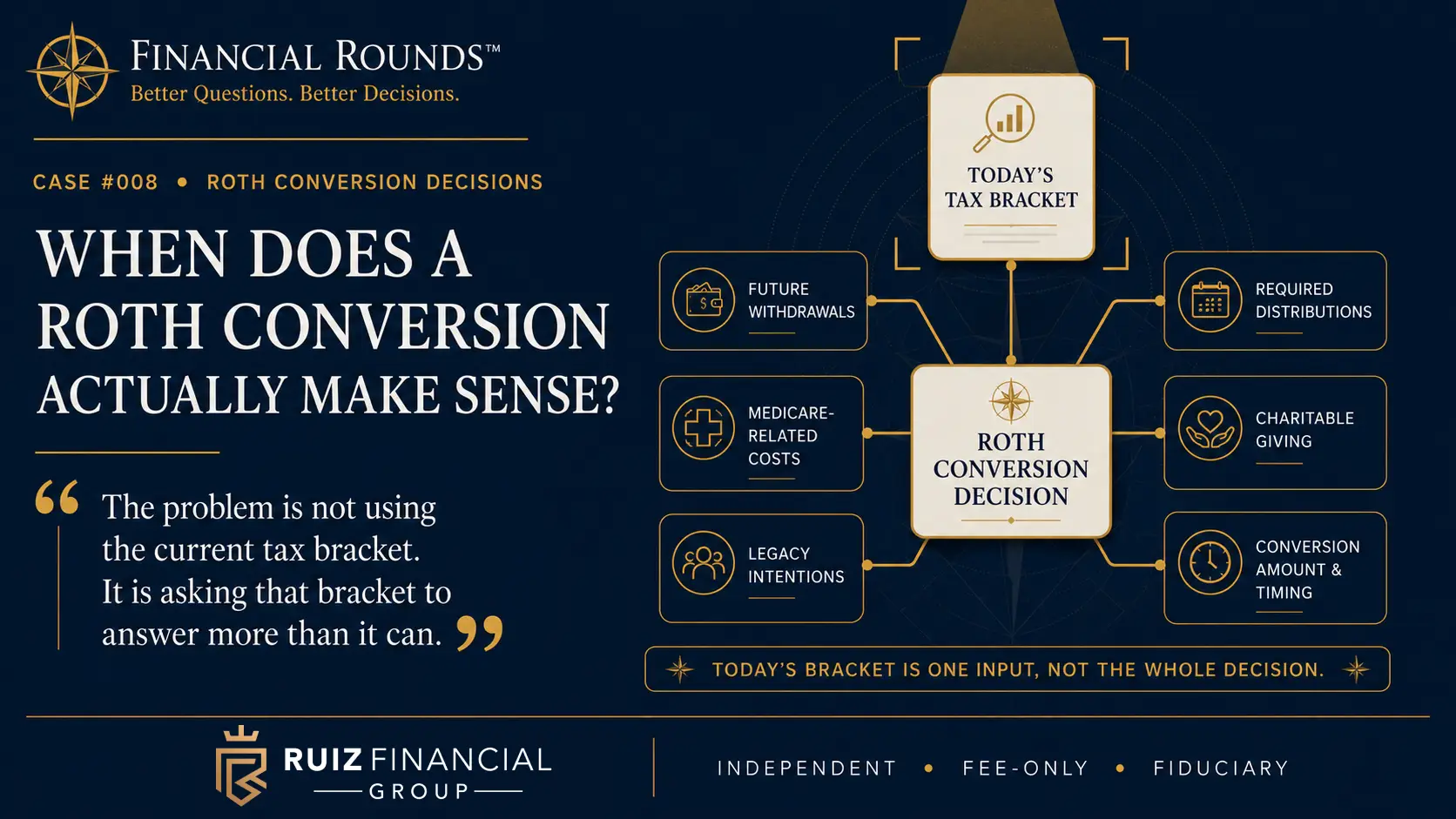
Case #008 • Roth Conversion Decisions
Why This Matters
A lower-income year can make a Roth conversion look especially attractive. The current tax rate is visible, and the decision can appear straightforward: pay tax now at a lower rate rather than risk paying at a higher rate later. That comparison matters. But by itself, it can make a multiyear decision look like a one-year tax calculation.The Diagnosis
The reasonable first question is:Am I in a low enough tax bracket to make a Roth conversion?That question begins with the immediate cost of the conversion. It does not necessarily capture what paying that tax now could change later. Consider a healthcare professional whose income is lower than usual during a career or retirement transition. The lower bracket looks like an opening, so a portion of a traditional IRA is converted to a Roth. The conversion may still make sense. But if the analysis stops with this year’s bracket, it can miss how the amount and timing interact with future withdrawals, required distributions, Medicare-related costs for some households, charitable intentions, or what beneficiaries may eventually inherit. The problem is not using the current tax bracket. It is asking that bracket to answer more than it can. The better question is:
What future taxes and financial decisions would this conversion change?
The Treatment
A Roth conversion moves money from one set of tax rules to another. Evaluating it requires looking beyond the year in which the conversion occurs. Current and expected future income are part of that evaluation. So are the amount converted, the timing of future withdrawals, and the other financial decisions the conversion may influence. A larger conversion in one year can create different tradeoffs than several smaller conversions over time. Future required distributions, Medicare-related costs, charitable giving, and legacy intentions may also affect the reasoning, although none of those considerations determines the answer by itself. The objective is not to identify a universally favorable year to convert. It is to understand which consequences matter in your situation and how they connect.Practical Takeaways
- Treat a lower tax bracket as a reason to examine a Roth conversion, not as the complete reason to make one.
- Ask what the conversion could change in future years, not just what it costs in the year it occurs.
- Evaluate the amount and timing of the conversion, not merely whether to convert.
Bottom Line
A lower tax bracket can make a Roth conversion worth examining. It does not make the decision by itself. The better analysis compares the tax paid now with the future decisions and tradeoffs the conversion could change. Before deciding how much to convert, ask:What else does it touch?
Continue Learning
• Explore how tax decisions take shape before filing →
• See how career decisions can affect financial independence →