

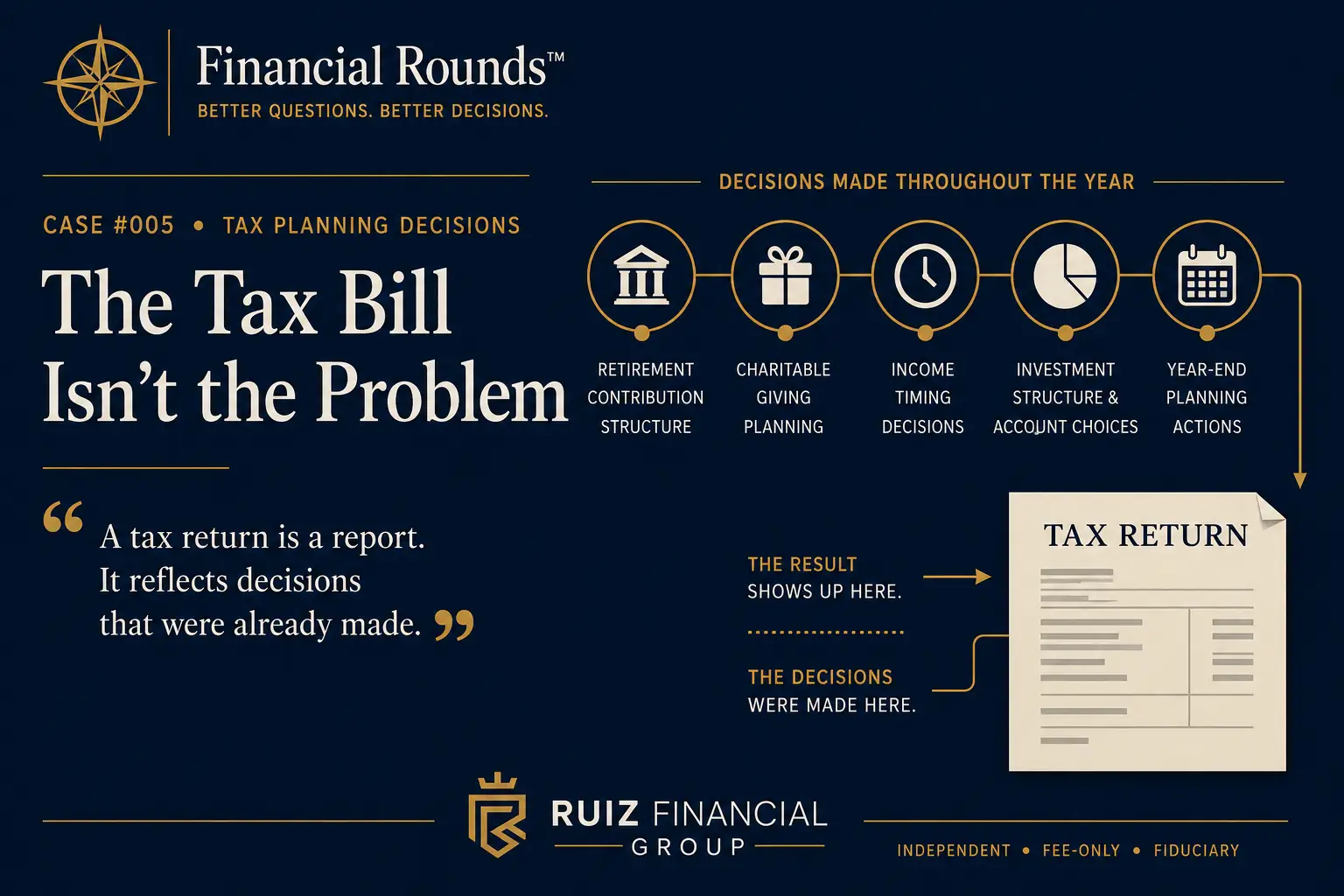
Case #005 • Tax Planning Decisions
Why This Matters for Physician Tax Planning
Effective physician tax planning often begins with the same question: how can I pay less in taxes?
It’s a reasonable question. It’s also usually being asked at the point when it is hardest to change the answer.
A tax return is a report. It reflects decisions that were already made, some of them many months earlier. By the time the number arrives, most of the decisions that shaped it have already been made.
The Diagnosis
The reasonable first question is:
How do I reduce this year’s tax bill?
That question assumes the tax bill is the decision. It isn’t. It is the result of several earlier ones.
Consider a physician who reviews a tax return each year, notices the number is higher than expected, and resolves to be more tax-efficient going forward. The following year arrives, the return is prepared, and the outcome feels remarkably familiar.
The physician did many of the things commonly associated with responsible financial management. Retirement contributions were made. Charitable gifts went out. The return was filed correctly and on time.
What never occurred was a deliberate tax-planning conversation early enough to influence the decisions appearing on the return. Reviewing taxes only when the return was prepared meant most of the relevant choices had already been finalized.
The better question is:
Which decisions, made today, will determine what next year’s return looks like?
The Treatment
A tax bill reflects choices that are often made without taxes being the primary consideration at the time: how retirement contributions are structured, how income is timed, how charitable giving is planned, which accounts hold different investments, and whether Roth or pre-tax contributions make more sense for that year. Retirement contribution decisions such as choosing between available workplace plans can have lasting tax consequences, as discussed in Financial Rounds™ Case #001. Contribution limits and related retirement-plan rules are updated periodically by the Internal Revenue Service.
Most people do not experience these as “tax decisions” in the moment. They feel like retirement decisions, giving decisions, investment decisions, or timing decisions. The tax consequence appears later, attached to a choice that was made for another reason.
The point isn’t to optimize every decision in isolation. It is to recognize that by the time a return is being prepared, many of the meaningful decisions are already behind you.
Practical Takeaways
- Treat tax planning as something that happens throughout the year, not only when the return is prepared.
- When making a retirement, giving, investment, or income-timing decision, consider what it may mean for a future tax return.
- Review not only what a return shows, but which earlier decisions produced it.
Bottom Line
A tax return tells you what happened. It doesn’t tell you what to do next.
Before making a financial decision that may appear on a future tax return, ask:
What else does it touch?
Continue Learning
• Explore another Financial Rounds™ case → Case #004: Your Biggest Asset Doesn’t Appear on Your Balance Sheet
• Explore a connected retirement-plan decision → Case #001: 403(b) + 457(b): Can You Contribute to Both?