
Case #010 • Financial Decision Follow-Through
Why This Matters
It is common to agree with a piece of financial advice, intend to act on it, and never fully carry it out. A retirement contribution was supposed to increase. A bonus was supposed to go somewhere specific. A conversation was supposed to happen every year and stopped happening after the first. When that happens, the explanation usually points inward.The Diagnosis
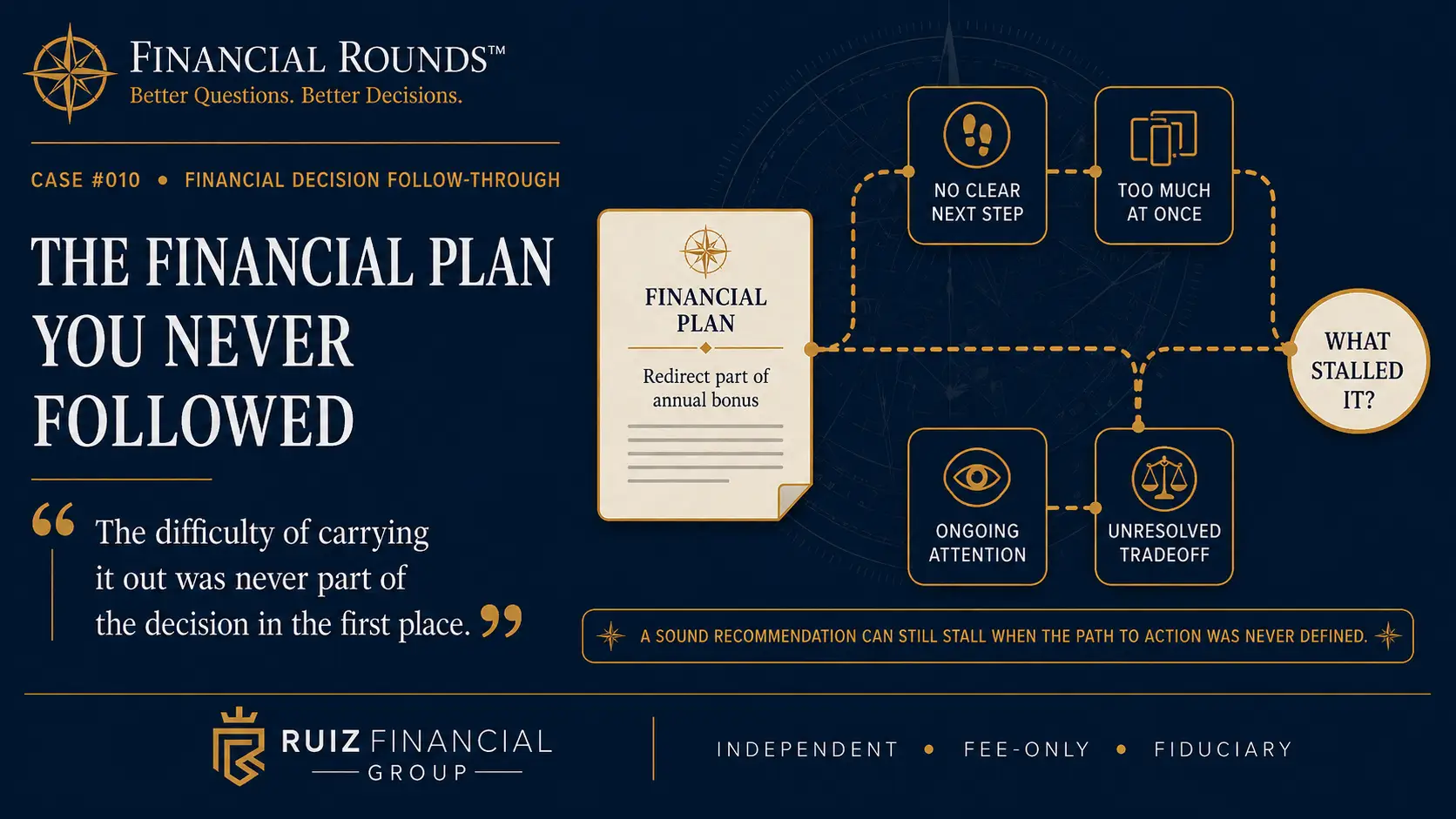
The reasonable first question is:Why didn’t I follow the plan?That question tends to produce the same handful of answers: not enough discipline, not enough time, not enough organization. Each answer puts the explanation on the person. That can feel honest, but it also ends the inquiry before it reaches the plan itself. Consider someone who agrees to redirect part of an annual bonus into a specific account. The reasoning is sound, and there is no disagreement with the advice. The first year, the bonus arrives, some of it goes toward immediate expenses, and by the time anyone thinks about the transfer, the money has already been absorbed into everyday spending. The second year goes the same way. Nothing about the advice was wrong. But the plan assumed a moment that never quite existed: a point when the bonus would remain clearly separate and wait for a decision. In practice, it arrived and dispersed within the same week. The plan never accounted for how quickly that could happen or what would need to intercept it. The problem is not that the recommendation was ignored. It is that the difficulty of carrying it out was never part of the decision in the first place. The better question is:
What made this recommendation difficult to carry out in my actual life?
The Treatment
A recommendation can be entirely sound and still fail if the friction involved in acting on it was never examined. Sometimes a plan introduces several changes at once. Each one may be reasonable, but together they compete for the same attention and follow-through. Other times, a recommendation does not specify what happens next. The exact moment to act never clearly arrives, the way a bonus can come and go before anyone decides where it should go. A plan can also assume a level of ongoing attention, checking, adjusting, and revisiting, that made sense during the original conversation but does not match how often the decision gets reconsidered afterward. And sometimes a recommendation leaves a real tradeoff unresolved. Competing priorities, a spending habit, or a family circumstance remain outside the plan, so the recommendation sits beside that tension rather than accounting for it. None of this means the original advice should be abandoned. It means the reasons it stalled are worth identifying specifically rather than filing them away as a lack of discipline.Practical Takeaways
- When a recommendation goes unfollowed, examine what the plan required you to do, not just whether you did it.
- Ask whether the plan assumed a moment or habit that does not exist in how you operate.
- Treat unresolved tradeoffs as part of the plan to revisit, not a private failure to carry alone.
Bottom Line
A financial plan can be well reasoned and still go unfollowed if the friction required to carry it out was never treated as part of the decision. Before deciding a recommendation did not work, ask what it was asking you to do.What else does it touch?
Continue Learning
• Explore why understanding expectations matters before a relationship begins →
• See how to distinguish routine information from decisions that need attention →