

Case #003 • Career Decisions for Physicians
Why This Matters
Accepting a physician employment agreement can feel surprisingly simple.
The salary exceeds expectations. The signing bonus looks attractive. The benefits seem competitive. It’s easy to feel ready to say yes.
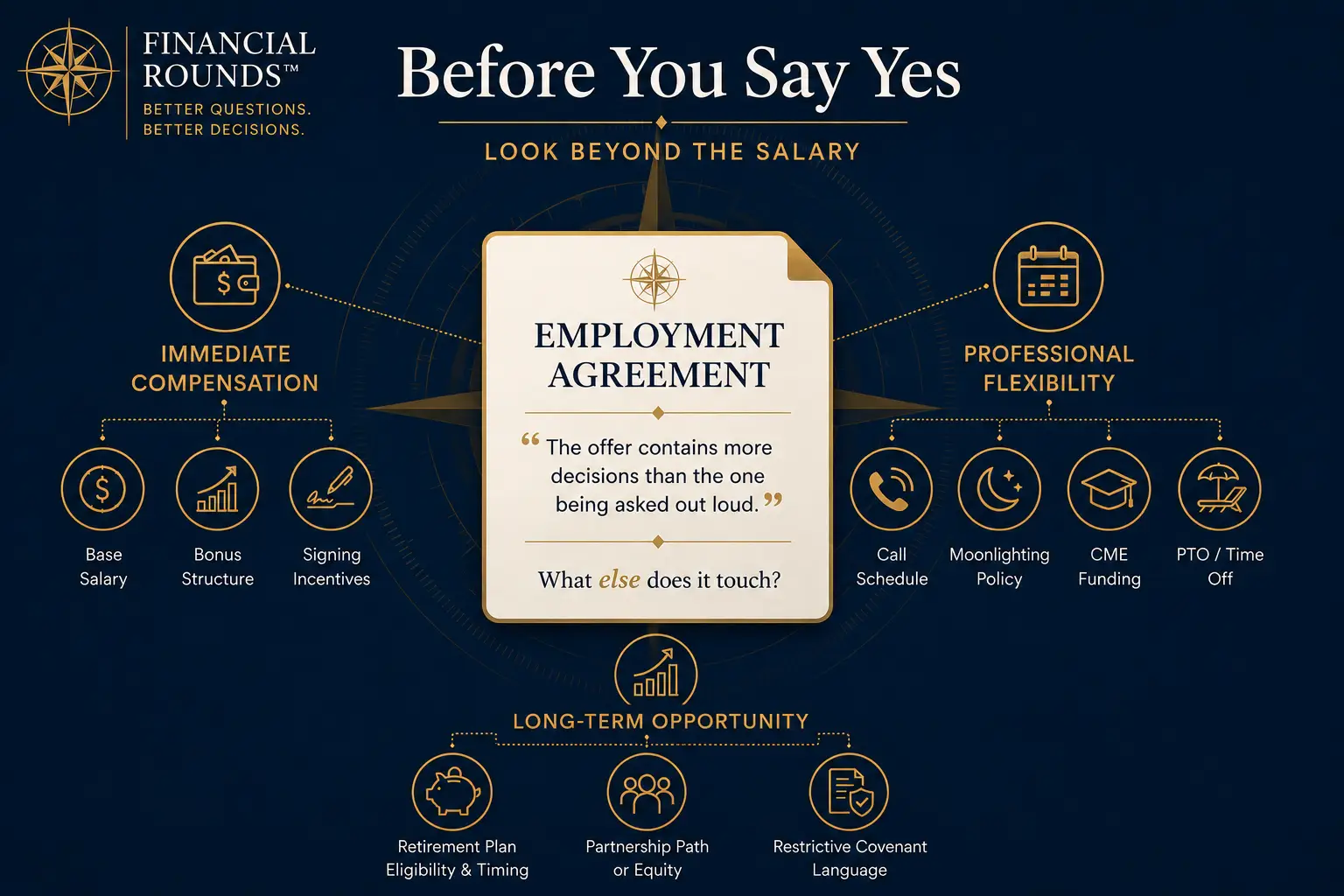
But an offer usually contains more decisions than the one being asked out loud. Compensation packages carry provisions that keep affecting income, flexibility, taxes, retirement savings, and future opportunities long after the starting salary has been negotiated, accepted, and forgotten.
The real question isn’t whether an offer is good. It’s whether everything the offer is actually deciding has been recognized.
The Diagnosis
The reasonable first question is:
Should I accept this offer?
That question assumes there’s one decision to make. There usually isn’t.
Consider two physicians who receive nearly identical salaries at the same organization, five years apart. One negotiates the terms around the salary: CME funding, call schedule, retirement plan eligibility, the partnership timeline, relocation support, the language in the non-compete. The other focuses on the number and moves quickly to accept.
Five years later, their salaries look almost the same. Their careers don’t.
Neither physician made an obviously bad decision. The difference wasn’t a single bad choice, it was several ordinary ones, made without being fully seen at the time.
The better question is:
Have I identified everything this offer is actually asking me to decide?
The Treatment
One way to evaluate an offer is to separate the decisions it contains, since different provisions carry different kinds of weight.
Immediate compensation covers what’s easiest to compare: base salary, bonus structure, signing incentives.
Professional flexibility covers what shapes day-to-day life: call schedule, moonlighting policy, CME funding, PTO.
Long-term opportunity covers what compounds over years: retirement plan eligibility and timing, the path to partnership or equity, and restrictive covenant language that could limit future options.
The point isn’t to negotiate every category. Plenty of offers are genuinely fine as written. The point is to see all three categories clearly before deciding, rather than evaluating the offer almost entirely through the first one.
Practical Takeaways
- Evaluate salary separately from everything that surrounds it.
- Ask which provisions will still matter five years from now, not just on day one.
- Understand which terms could affect future opportunities, especially restrictive covenants, before signing.
Bottom Line
Every important financial decision affects more than the question that’s immediately in front of you.
Before saying yes, ask:
What else does it touch?
Continue Learning
• Read another Financial Rounds™ case → Case #002: Fee-Only Isn’t the Question That Matters Most
• Explore a physician guide covering related financial decisions → 9 Money Mistakes Doctors Make